
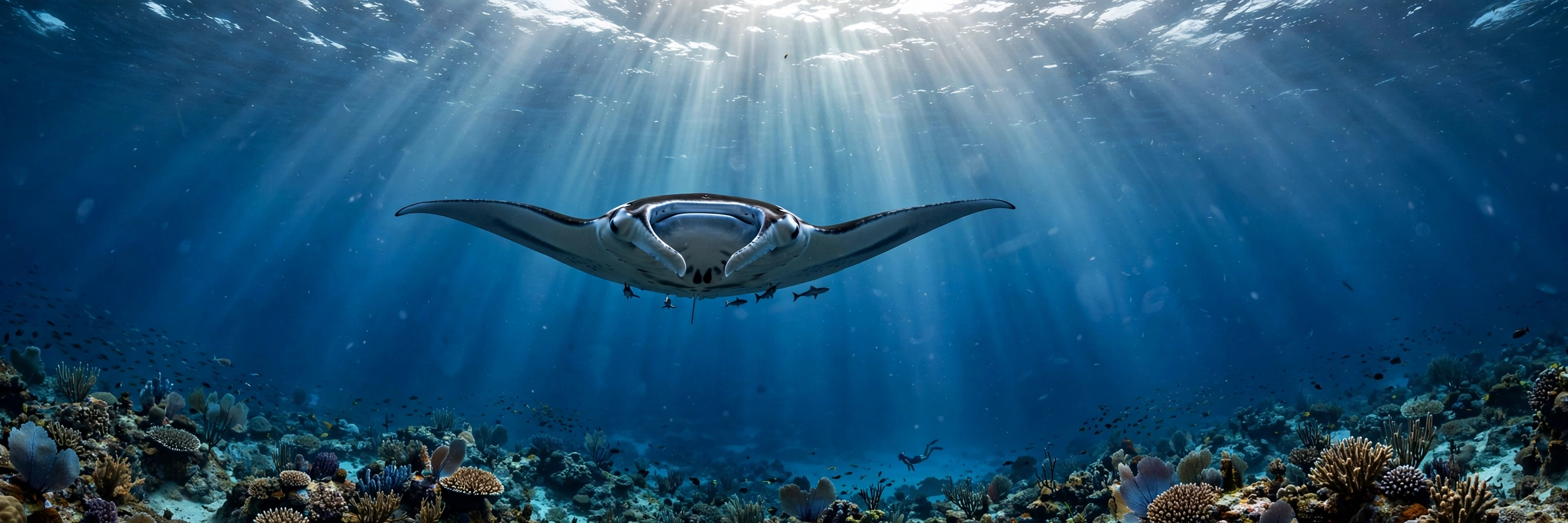
The first time a manta ray comes toward you, your brain does something odd: it stops believing the size. A wingspan wider than a car, gliding straight at you — and completely harmless. Mantas don't swim so much as fly, and unlike almost every other giant in the ocean, they seem just as interested in you.
Below are the destinations from our manta article — the same six, nothing padded — each linked to its destination guide on this site, with the months it is typically seen and the tag line our own catalog gives it. Sightings are never guaranteed — right site, right month, and the odds are good.
Where mantas are typically seen
Every destination below is from our own ranked catalog — each link opens its destination guide on this site. The months are the manta article's own; sightings are never guaranteed.
1. Maldives
Turtles, mantas and dreamlike atolls on the trade-wind side.
Typically seen May to November — the Hanifaru Bay feeding cyclone. Snorkel-only in the bay, by rule.
2. Hawaii
Volcanic reef gardens, green sea turtles and manta night snorkels in clear Pacific water.
Typically seen year-round — Kona; at night, lights draw plankton in and mantas feed right in front of snorkelers.
3. Yap, Micronesia
Reef mantas working shallow cleaning stations in the world’s first manta ray sanctuary — snorkeler-deep, and about as uncrowded as diving gets.
Typically seen year-round, best December to April — cleaning stations close to shore, famously reliable.
4. Raja Ampat
The richest reefs on Earth — unmatched biodiversity in glass-clear water.
Typically seen October to April — reef mantas at Manta Sandy, a classic cleaning station.
5. Ningaloo Reef
Australia's west-coast fringing reef — coral a few fin-kicks from the sand, whale sharks offshore.
Typically seen May to September — gentle reef mantas on Australia's west coast.
6. Komodo
Current-fed reefs where the marine life is as dramatic as the dragons.
Typically seen April to November — reef mantas in the current-swept channels at Manta Alley.
Snorkeling with mantas — the etiquette
Float, don't chase
Float, stay calm, and let it come to you — mantas approach still snorkelers more readily than chasing ones.
Hands off, path clear
Never touch, chase, or ride one, and never block its path; keep a few metres of water between you.
At the cleaning station
At a cleaning station, hang back and watch the whole ritual: the hovering, the wrasse, the slow turn for another pass.
That is the encounter
If it looks you in the eye, enjoy it. That is the encounter.
Book your Maldives snorkeling
Every button opens one of our booking partners live — tours on Viator, flights on Aviasales, hotels on Booking.com — where you set your own dates and see current prices and availability.
Affiliate links — we may earn a commission at no extra cost to you. No prices are shown here: each partner's live site shows prices and availability for your dates.
Meet the animal properly
Our full manta ray article — how they feed, the cleaning stations, and what the science says about their slow life:
The Manta Ray: A Giant That Flies Underwater →