
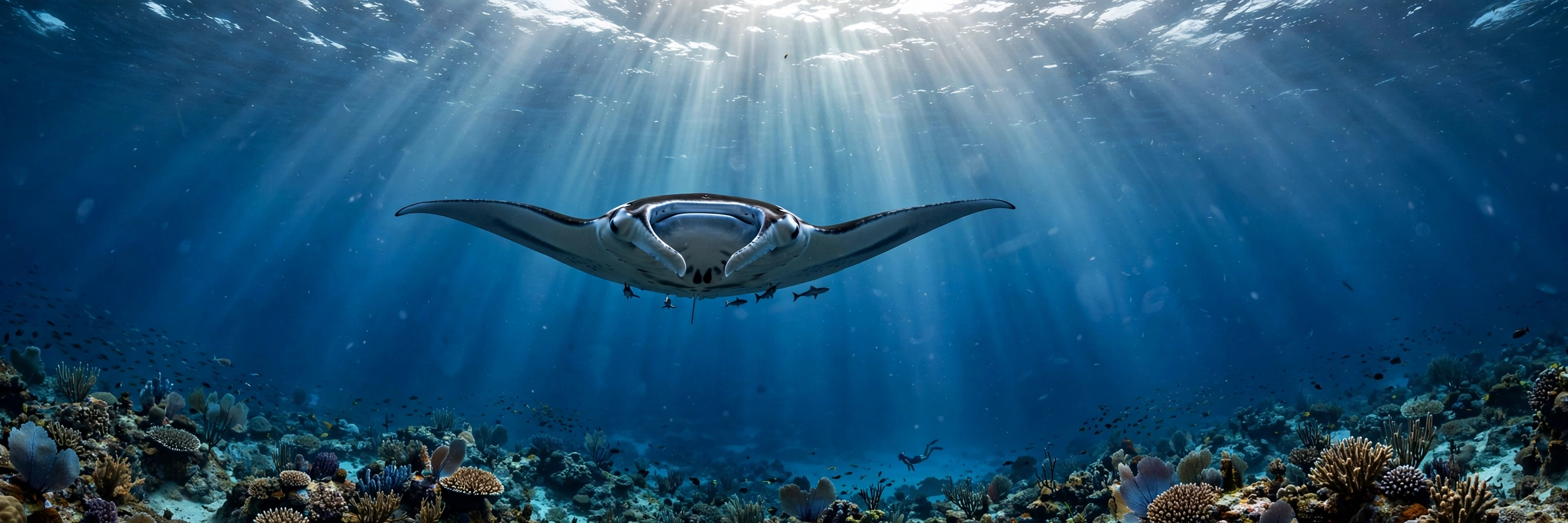
The first time a manta ray comes toward you, your brain does something odd: it stops believing the size. A wingspan wider than a car, gliding straight at you — and then it banks, slow and unbothered, and passes close enough to look you in the eye. Mantas don't swim so much as fly. And unlike almost every other giant in the ocean, they seem just as interested in you.
Two mantas, one family
There are two manta species, and snorkelers meet both. The reef manta (Mobula alfredi) is the regular: typically 3 to 3.5 metres across, up to about 5, living around coastal reefs and atolls and returning to the same reefs year after year. The giant oceanic manta (Mobula birostris) is the largest ray in the world, with a wingspan up to 7 metres, roaming the open ocean. Both are filter feeders. Both are completely harmless — no sting, no venomous spine, despite the old “devil ray” nickname. “Manta” is Spanish for blanket or cloak. And both are rays, cousins of sharks, with skeletons of cartilage, not bone.
Eating the smallest food in the sea
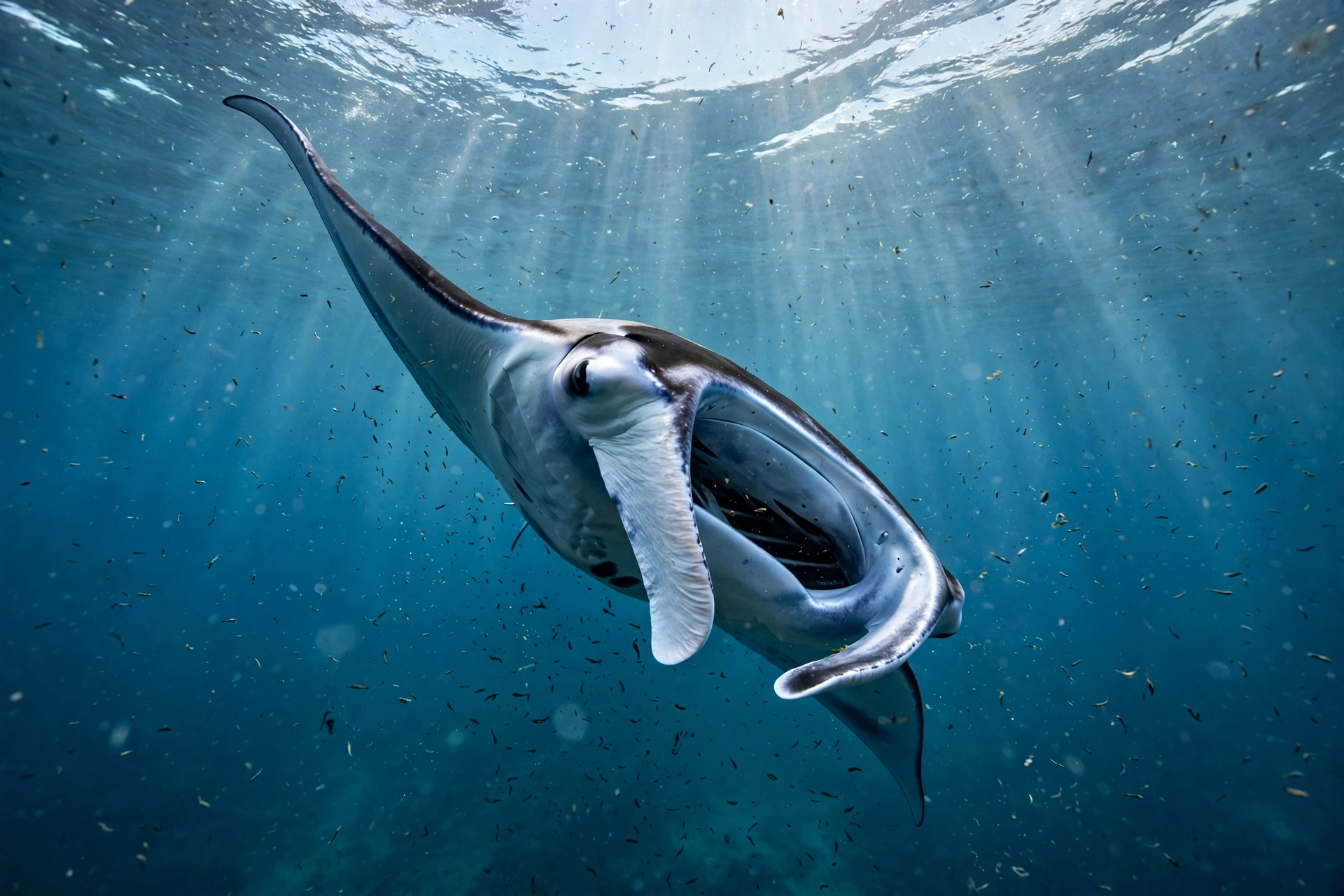
A five-metre animal that eats food you can barely see: zooplankton — copepods, tiny shrimp, crab larvae. Two cephalic fins, the “head fins” beside its mouth, unfurl to funnel plankton-rich water into a wide mouth, and gill plates sieve the meal out. When plankton is thick, mantas barrel-roll — somersaulting over and over to stay inside the patch. When it is really thick, they feed in chains and trains, one following another. And in Hanifaru Bay in the Maldives, hundreds spiral together into a feeding “cyclone” — one of the great wildlife spectacles in the sea.
The cleaning station
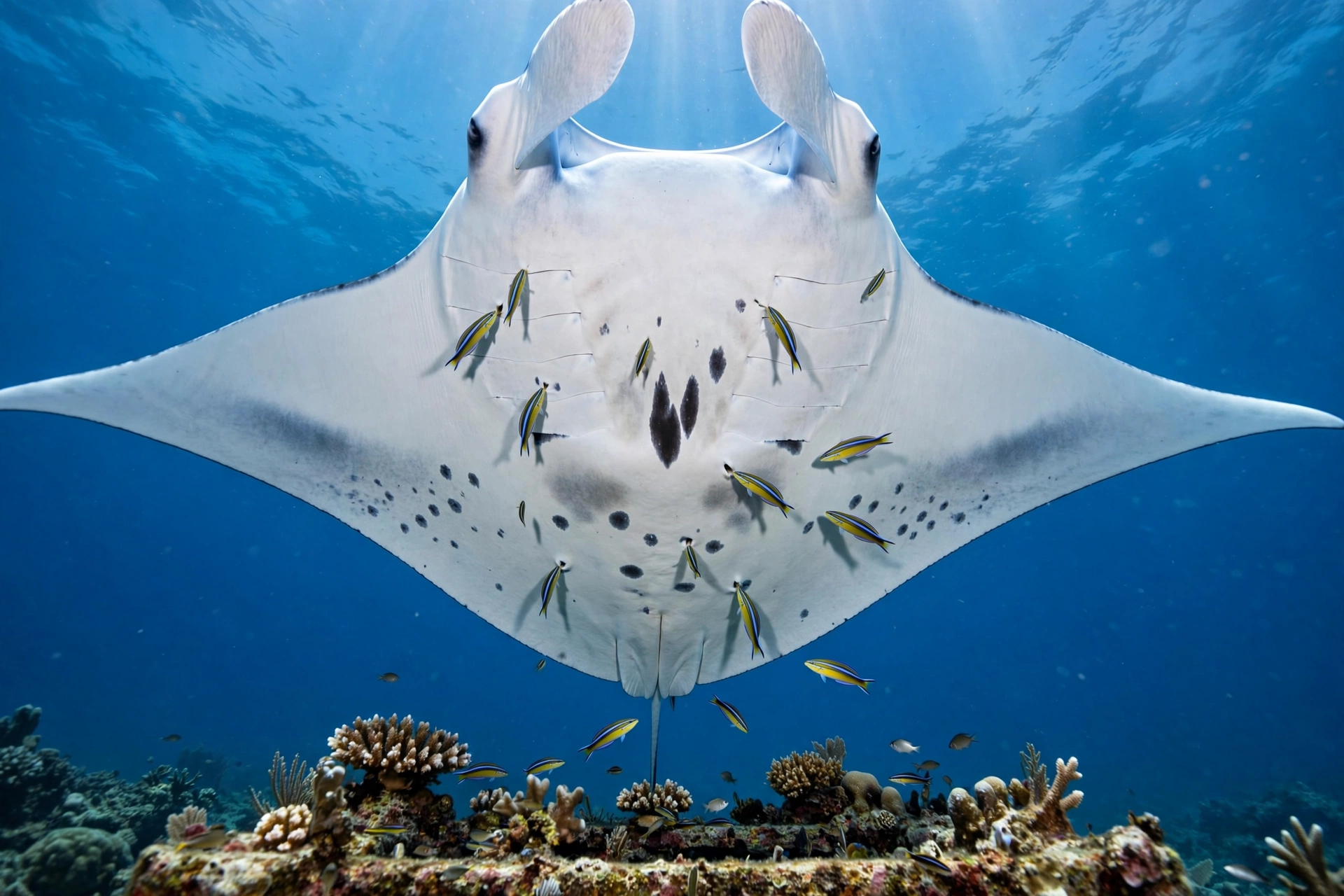
Between feeds, mantas visit reef cleaning stations and hover almost motionless while cleaner wrasse pick parasites and dead skin off them. They return to the same stations again and again; in some places they clean by day and feed offshore at night. Every manta carries its own identity card: the pattern of dark spots on its white belly is unique, like a fingerprint. Researchers photograph bellies to track individuals — in the Maldives alone, over 5,000 individuals have been photo-identified.
A brain, a memory, a slow life
Mantas have the largest brain-to-body ratio of any fish, and the long memory to match: they map their reefs, remember their stations, and return to them year after year. But the life that makes them so good at surviving also makes them fragile. They mature late, at 8 to 17 years, carry a single pup for 12 to 13 months, and may have only a handful of pups in a lifetime. They can live 40 years or more — a slow life in a fast-changing ocean. The reef manta is listed Vulnerable and the giant oceanic manta Endangered on the IUCN Red List. Their threats are targeted fishing for their gill plates, and accidental catch in other fisheries.
The young stay close. The adults roam.
Off Costa Rica, researchers tracked oceanic manta rays between 2018 and 2025, fitting 59 animals with acoustic transmitters and tracking 12 more by satellite, alongside photo identification. The pattern that came back was split by age.
The young ones stayed put. Smaller, immature mantas — around 3 to 3.5 metres across in this study — stayed within Costa Rica's coastal waters, returning again and again to the same coastal cleaning stations. Even sites only tens of kilometres apart saw very few animals moving between them. The researchers' reading is that the young don't risk the long crossings, likely because large predators such as orcas and tiger sharks are a real threat at that size — and the study found plenty of animals bearing wounds shaped like bites from large predators.
The larger, mature animals — around 4 to 4.5 metres across — told a different story. They undertook long-distance journeys of hundreds of kilometres, some reaching as far as the waters off Guatemala. And once they left the monitored coastal sites, they moved through waters with no protection at all, exposed to fishing and vessel traffic.
That gap is the heart of the study's conservation call: coastal havens only protect these animals for part of the year, so the corridors between them — their swimways — need protecting too. Mantas reproduce slowly and take years to reach maturity, so every adult lost on an unprotected stretch of corridor is hard to replace.
What the study doesn't settle — stated plainly
What prompts a young manta to eventually join the migratory population is still unclear. The researchers suspect feeding and breeding grounds in highly productive waters across Central America may play a role, but that is a suspicion, not a finding.
How mantas navigate back to particular cleaning stations is not yet known.
The tracking raises the possibility that Central America holds its own distinct manta population, rather than animals migrating from populations elsewhere — but that is a possibility under investigation through genetic work, not a conclusion.
And the findings describe the animals actually tracked off Costa Rica between 2018 and 2025, not every manta everywhere.
Source: telemetry study of oceanic manta rays off Costa Rica, tracked between 2018 and 2025, published in Frontiers in Fish Science, as reported in October 2026.
Where to see them
Sightings are never guaranteed — right site, right month, and the odds are good.
- Maldives — Hanifaru Bay, Baa Atoll: the feeding cyclone, May to November. Snorkel-only in the bay, by rule — which suits us perfectly.
- Hawaii — Kona: year-round. At night, lights draw plankton in and mantas feed right in front of snorkelers.
- Yap, Micronesia: year-round, best December to April. Cleaning stations close to shore, famously reliable.
- Raja Ampat — Manta Sandy: October to April, reef mantas at a classic cleaning station.
- Ningaloo Reef: May to September, gentle reef mantas on Australia's west coast.
- Komodo — Manta Alley: April to November, reef mantas in the current-swept channels.
Where to swim with manta rays — the destination-by-destination guide →
Meeting one on the reef
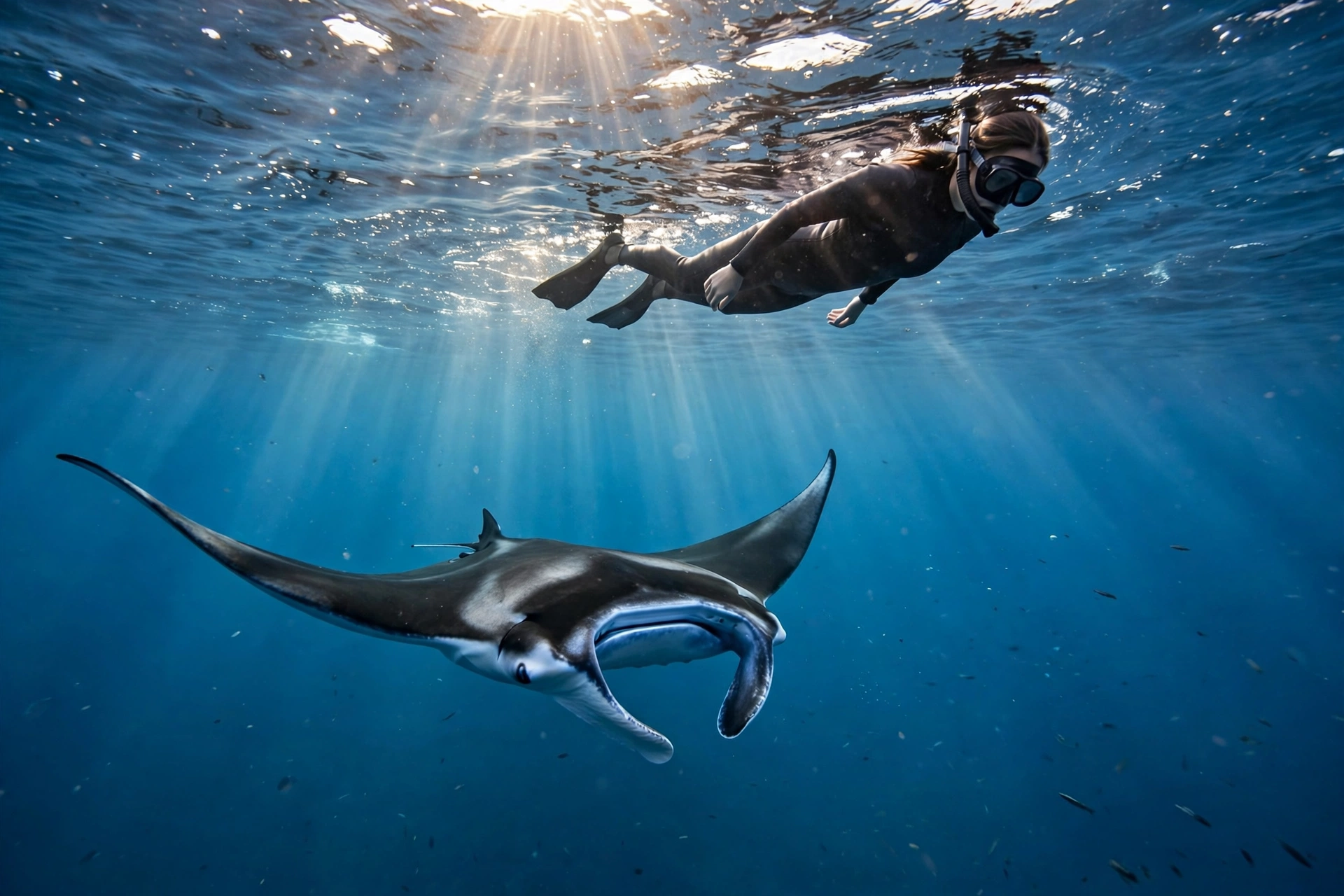
Float, stay calm, and let it come to you — mantas approach still snorkelers more readily than chasing ones. Never touch, chase, or ride one, and never block its path; keep a few metres of water between you. At a cleaning station, hang back and watch the whole ritual: the hovering, the wrasse, the slow turn for another pass. If it looks you in the eye, enjoy it. That is the encounter.
Sources
- IUCN Red List: reef manta ray (Mobula alfredi) — Vulnerable; giant oceanic manta ray (Mobula birostris) — Endangered (uplisted 2019). Manta Trust / Maldives Manta Conservation Programme — photo-ID database and Hanifaru Bay. Save Our Seas Foundation — reef manta behaviour and reproduction. Florida Fish & Wildlife Conservation Commission — giant manta size. Barrier Reef Australia — manta facts (brain ratio, fingerprint spots).