
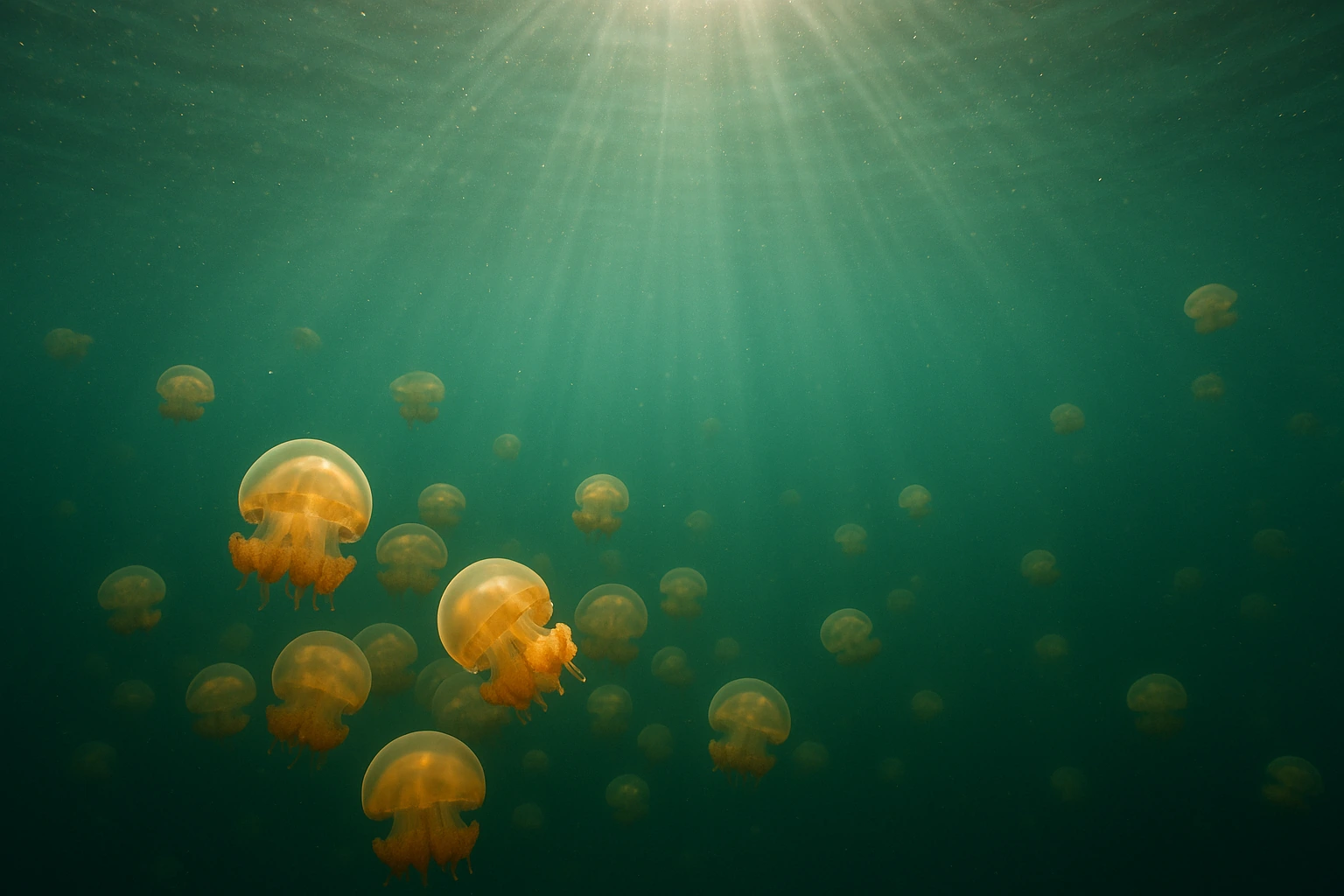
Snorkelers tend to file jellyfish under "hazard." Some deserve that caution. But the ones on this page are the other kind: the drifters worth slowing down for.
Jellyfish numbers rise and fall with water temperature and season, so check conditions before you travel — sightings are never guaranteed. Below: the encounters the jellyfish article itself names, honestly framed — one you can swim, one that is view-only for now, and two to understand before you get in.
Where the gentle ones are
Palau — Jellyfish Lake (Ongeim'l Tketau)
Drowned limestone islands, a jellyfish lake and current-fed channels.
The lead swim-with spot: golden jellyfish and moon jellies in a landlocked saltwater lake in the Rock Islands, snorkel only — scuba is not permitted. Golden jellyfish keep their stinging cells, but the sting is so mild most snorkelers never feel it. The rules are absolute: do not touch the jellyfish, and skip chemical sunscreen (Palau bans reef-toxic products). A Koror State permit is required, and the lake has closed to visitors at times to let the population recover — so check current conditions and rules with your operator the week you travel.
Typically seen: no month window in our data — numbers swing with season, so check current conditions with your operator the week you travel.
Kakaban Island (Derawan Islands, Indonesia)
VIEW-ONLY FOR NOW: a brackish marine lake holding four jellyfish kinds that do not sting people (moon, spotted, upside-down, and a tiny box jellyfish under a centimetre). After a late-2023 decline the lake closed and reopened in 2025, but swimming with the jellyfish is not yet allowed, to support recovery — enjoy the lake from its edge or boardwalk instead, and confirm locally before you go. No sunscreen in the lake; do not touch the animals.
Typically seen: no month window in our data — and no swim for now: view-only until local rules change.
Caribbean and Florida mangrove lagoons
Upside-down jellyfish rest bell-down on the sand in shallow, sheltered water. The article's warning, as it states it: their mucus carries tiny stinging-cell bundles that can make the water itself feel itchy or irritating even without direct contact — give the beds a wide berth and cover up if you swim nearby.
Typically seen: no month window in our data.
Temperate coastal waters worldwide
Moon jellies — a clear saucer with four horseshoe shapes visible in the bell — drift through bays and inshore waters. Their sting is mild, often barely felt. No destination needed, just a calm day and a look below the surface.
Typically seen in season; no month window in our data.
Floating with jellyfish — the etiquette
Let it drift
Float, stay still, and let it drift.
Hands off
Never touch a jellyfish, chase one, or try to hold one up for a photo.
Around the edge, not through the middle
Give every animal a wide berth, and give a whole bloom even more: swim around the edge, not through the middle.
In the lake, absolute
In Palau's lake, that rule is absolute. No touching, no sunscreen in the water, no fins kicking through the drift.
Leave it as you found it
You are a guest in their nursery, and the encounter is better for leaving it exactly as you found it.
Book your Palau snorkeling
Every button opens one of our booking partners live — tours on Viator, flights on Aviasales, hotels on Booking.com — where you set your own dates and see current prices and availability.
Affiliate links — we may earn a commission at no extra cost to you. No prices are shown here: each partner's live site shows prices and availability for your dates.
Meet the animal properly
Our full jellyfish article — 500 million years of drifting, the gentle ones, and the honest safety side (including what to do — and not do — for a sting):
The Jellyfish: Older Than Dinosaurs, Made of Almost Nothing →