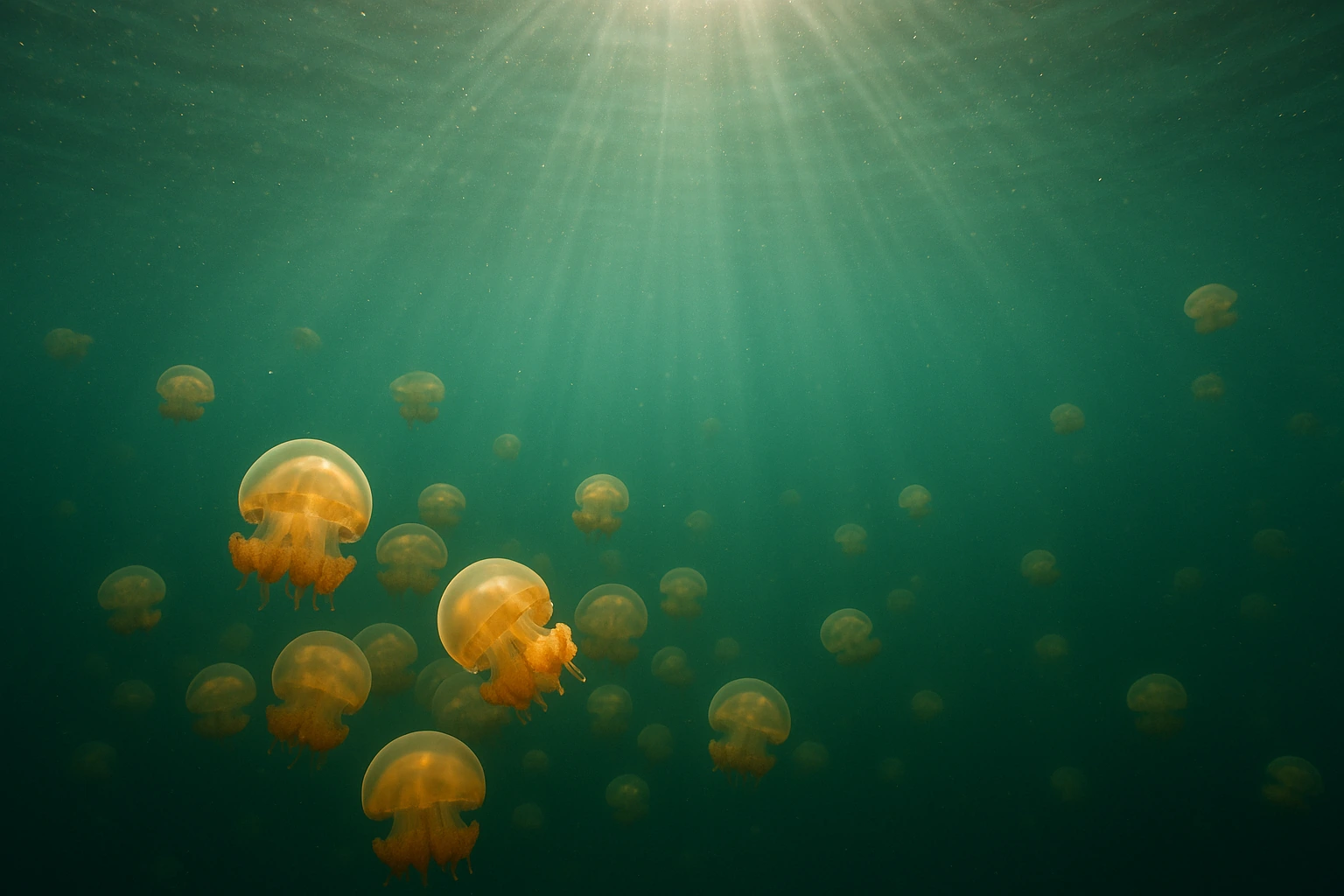
A jellyfish does not chase you, show off, or perform. It drifts. It pulses. And if you float quietly beside one, you are watching one of the oldest animal designs on Earth doing exactly what it has done for more than 500 million years: moving water through a bell, trailing stinging threads, and getting by with no brain, no heart, and no bones at all.
That simplicity is the wonder. A jellyfish is roughly 95 percent water, coordinated by a loose nerve net instead of a brain, and it still hunts, navigates toward light, and blooms in numbers that can fill a whole lake.
Snorkelers tend to file jellyfish under 'hazard.' Some deserve that caution. But the ones in this page are the other kind: the drifters worth slowing down for.
An animal made of almost nothing
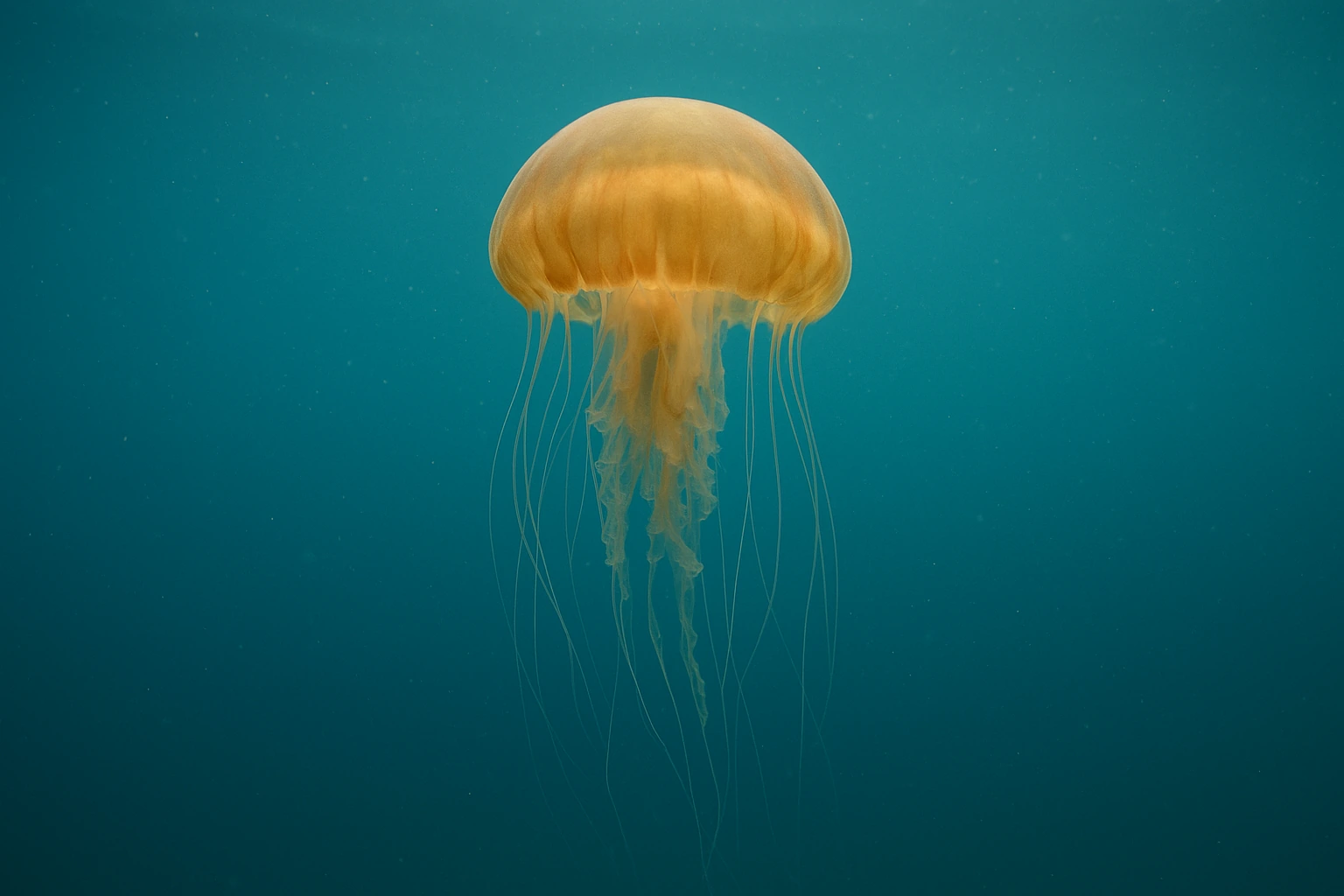
A jellyfish moves by squeezing its bell, pushing water out behind it in a slow pulse. It has no brain to plan with and no heart to pump with. Oxygen and food simply diffuse through a body so thin and watery that it barely needs plumbing. Its hunting gear is a set of tentacles armed with nematocysts, microscopic capsules that fire tiny harpoons on contact. Those harpoons are what sting you, and they are also how a creature with no brain catches dinner: plankton, small fish, whatever drifts too close. The family is enormous, thousands of species, found from icy Arctic water to the tropics and along every coastline. Most snorkelers will never meet the dangerous few. The ones below are the encounters to seek out, plus the honest safety notes for everywhere else.
The gentle ones
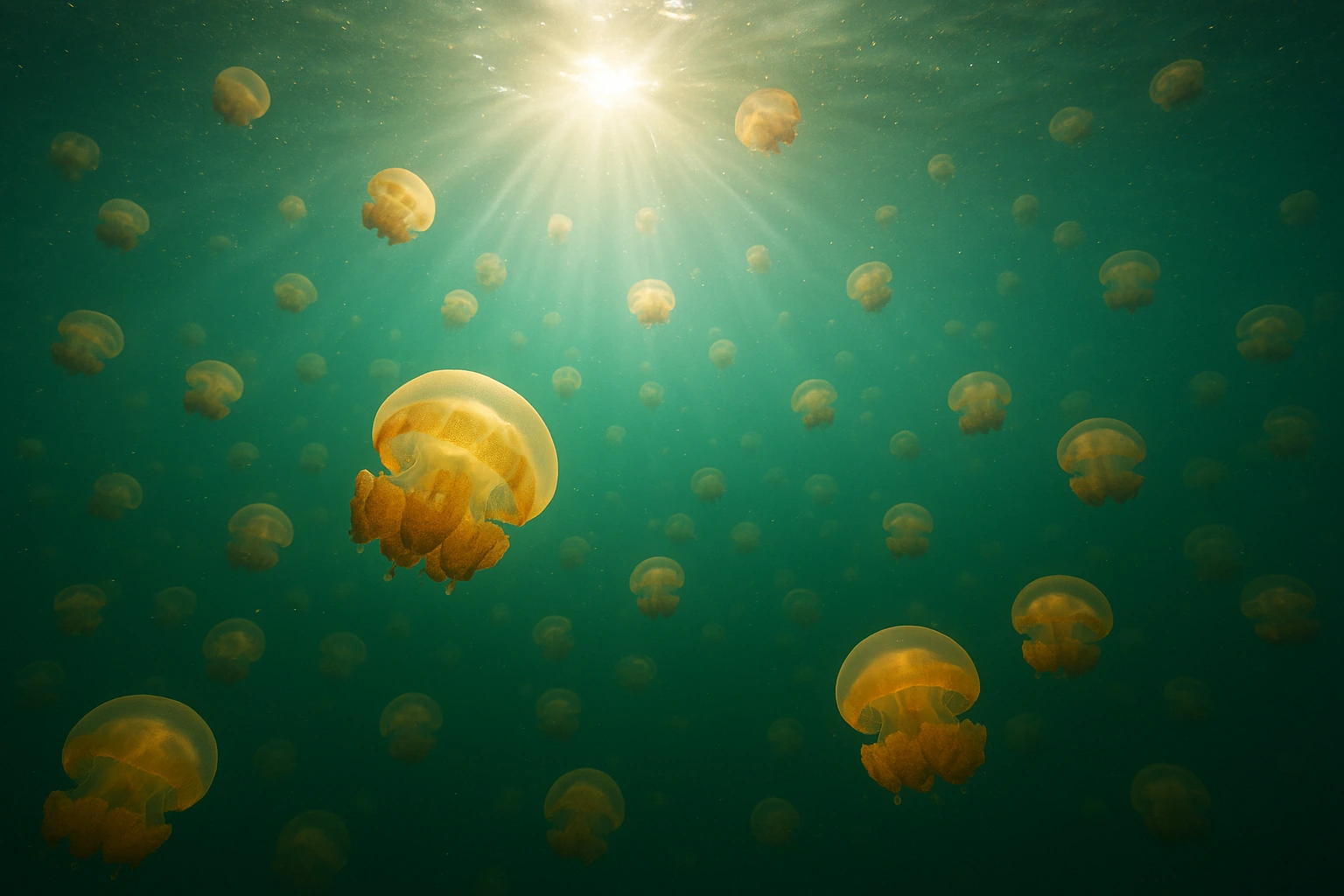
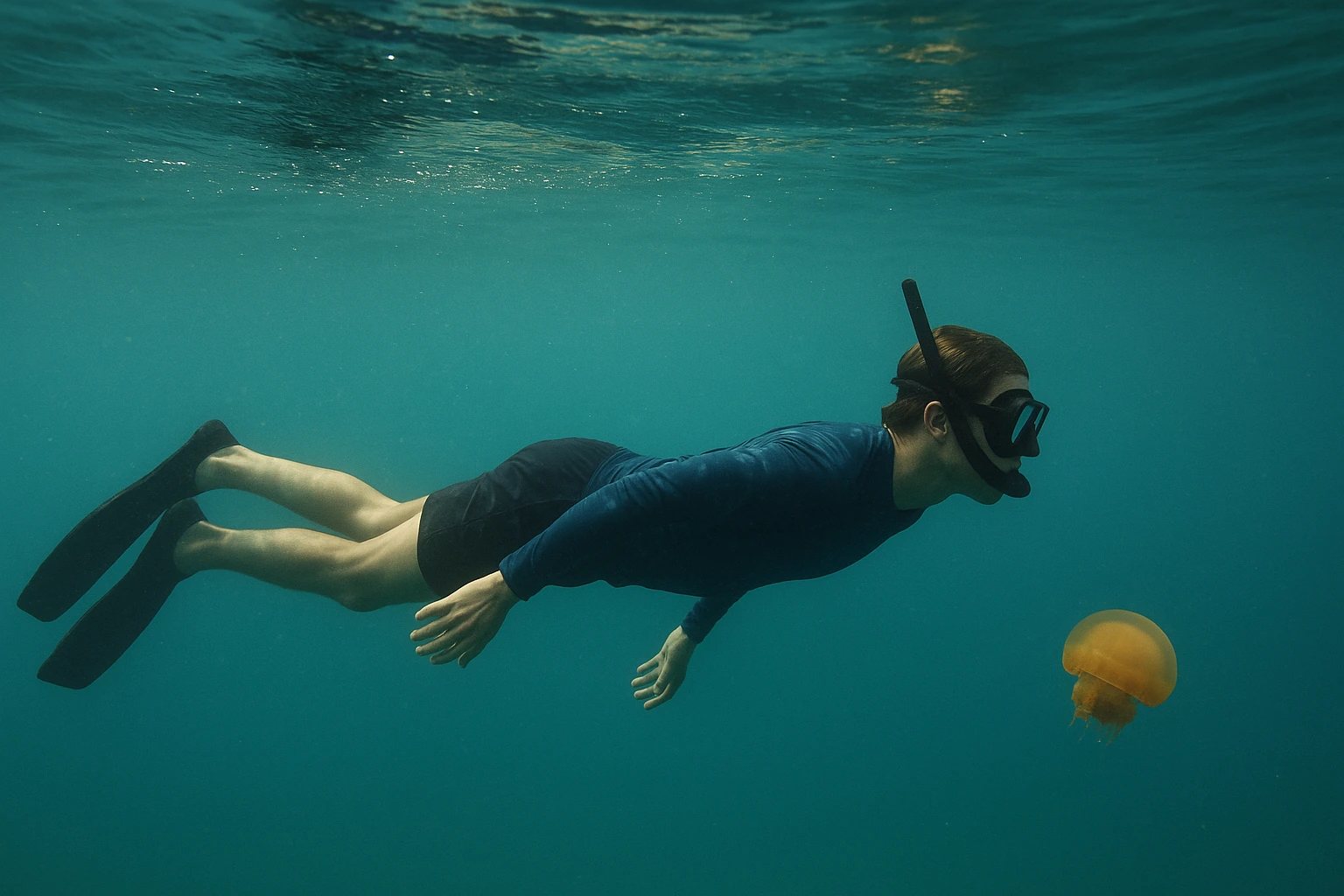
The golden jellyfish of Palau's Jellyfish Lake carry algae inside their tissues, and the algae need sunlight. So every day the jellyfish follow the sun across the lake, turning slowly so their passengers get even light, then sink deeper at night to feed on nutrients below. You float among them while they do their rounds, bells the colour of amber, close enough to see the pulse. Moon jellies are the other gentle classic: a clear saucer with four horseshoe shapes visible in the bell, drifting through temperate coastal waters around the world. Their sting is mild, often barely felt. Then there is the upside-down jellyfish, which does everything backwards. It rests bell-down on the seabed in shallow mangrove lagoons, arms pointing up, farming sunlight for the algae inside it. It looks like a flower lying on the sand. It is not sick or stranded. That is simply how it lives. And one small marvel deserves a line of its own: the immortal jellyfish, a creature only a few millimetres across, can reverse its own life cycle when damaged or starved, returning from adult back to polyp and starting again. It can still be eaten or fall ill. It is not truly immortal. But no other animal we know bends the rules quite like that.
The honest safety side
Most jellyfish stings are painful but not dangerous: an immediate burning feeling, red welts or stripes where the tentacles touched, and itching that can linger. A few kinds are a different matter, and snorkelers should know the difference before they get in. The box jellyfish, found in tropical northern Australia and parts of Southeast Asia, can deliver a sting severe enough to be life-threatening. The Irukandji, a tiny jellyfish of tropical Australian waters with a bell barely the size of a thumbnail, can produce severe symptoms that arrive after the sting itself. The Portuguese man o' war is not a true jellyfish at all but a colony of organisms working together, and its long tentacles give a famously painful sting. Dead jellyfish washed up on a beach can still sting, so admire those from a distance too.
- Get out of the water and stay calm. Ask a lifeguard or someone with first aid training for help.
- Rinse the area with seawater, never fresh water. Fresh water can trigger unfired stinging cells to discharge and make the sting worse.
- Remove any tentacles still on the skin with tweezers or the edge of a bank card. Do not use bare hands, and do not rub the area.
- Soak the sting in very warm water, as hot as you can tolerate, for at least 30 minutes. Hot flannels or towels work if you cannot soak it.
- Take a simple painkiller if you need one.
What not to do: do not pee on the sting, do not rub it with sand or a towel, and do not reach for vinegar by default. Vinegar is the exception that proves the rule: for a box jellyfish sting, dousing the area with vinegar for 30 seconds before removing tentacles is the recommended step, because it stops unfired stinging cells from discharging. For most other jellyfish, including the moon jellies and barrel jellies common in European waters, vinegar can trigger more stinging cells to fire and make things worse. If you do not know what stung you, seawater and warm water are the safe defaults, and local advice beats any general rule. Get emergency help straight away if there is difficulty breathing, chest pain, seizures, severe swelling, vomiting, or lightheadedness, if the sting is on the mouth, throat, or near the eyes, if pain is severe and will not ease, or if a child has been stung. A sting in a tropical country deserves prompt medical attention even when it first seems mild.
Where to see them
Jellyfish numbers rise and fall with water temperature and season, so check conditions before you travel. Sightings are never guaranteed.
- PALAU — Jellyfish Lake (Ongeim'l Tketau), Eil Malk, Rock Islands — the lead swim-with spot: golden jellyfish and moon jellies in a landlocked saltwater lake, snorkel only; golden jellyfish keep their stinging cells but the sting is so mild most snorkelers never feel it; scuba not permitted (hydrogen sulphide below about 15 metres); do not touch the jellyfish; skip chemical sunscreen (Palau bans reef-toxic products); as of October 2026 secondary travel guides report the lake open for snorkeling with a US$100 Koror State Jellyfish Lake permit (ages 6+, also covering the Rock Islands; Rock Islands-only permit US$50); numbers swing with season (a September 2026 Coral Reef Research Foundation survey put golden jellyfish in its top band, 100,000+, but the population crashed in 2016, recovered enough to reopen in 2019, and the lake has closed to visitors at times since) — so check current conditions with your operator the week you travel.
- INDONESIA — Kakaban Island, Derawan Islands, East Kalimantan — VIEW-ONLY FOR NOW: a brackish marine lake holding four jellyfish kinds that do not sting people (moon, spotted, upside-down, and a tiny box jellyfish under a centimetre); after a late-2023 decline the lake closed and reopened in 2025, but current 2025–2026 reporting says swimming with the jellyfish is not yet allowed to support recovery — enjoy the lake from its edge/boardwalk instead, do not plan a swim there until local rules change; older guides still describe snorkel-only visits, so confirm locally before you go; no sunscreen in the lake, do not touch the animals.
- CARIBBEAN AND FLORIDA MANGROVE LAGOONS: upside-down jellyfish resting on the sand in shallow, sheltered water; a warning: their mucus carries tiny stinging-cell bundles that can make the water itself feel itchy or irritating even without direct contact, so give the beds a wide berth and cover up if you swim nearby.
- TEMPERATE COASTAL WATERS WORLDWIDE: moon jellies drifting through bays and inshore waters in season; no destination needed, just a calm day and a look below the surface.
Meeting one on the reef
Float, stay still, and let it drift. Never touch a jellyfish, chase one, or try to hold one up for a photo. Their bells tear easily, and a careless hand is the fastest way to turn a gentle encounter into a sting. Give every animal a wide berth, and give a whole bloom even more: swim around the edge, not through the middle. In Palau's lake, that rule is absolute. No touching, no sunscreen in the water, no fins kicking through the drift. At Kakaban, stay to the viewing edge — no swimming for now. You are a guest in their nursery, and the encounter is better for leaving it exactly as you found it.
Jellyfish facts
- No brain, no heart, no bones, no blood. A jellyfish is roughly 95 percent water, run by a nerve net.
- Jellyfish have been drifting through the oceans for more than 500 million years, longer than dinosaurs, trees, or sharks.
- Thousands of species, from icy Arctic water to the tropics, along every coastline.
- They move by pulsing the bell, squeezing water out behind them.
- Their sting comes from nematocysts, microscopic capsules on the tentacles that fire tiny harpoons on contact.
- Golden jellyfish farm algae inside their tissues and follow the sun across the lake each day so the algae get light.
- Upside-down jellyfish rest bell-down on the seabed, arms up, for the same reason: sunlight for their algae.
- The immortal jellyfish, only a few millimetres across, can reverse its life cycle from adult back to polyp when damaged or starved.
- Box jellyfish carry clusters of eyes, some with lenses, wired to no brain at all.
- A beached jellyfish can still sting. Admire it from a distance.