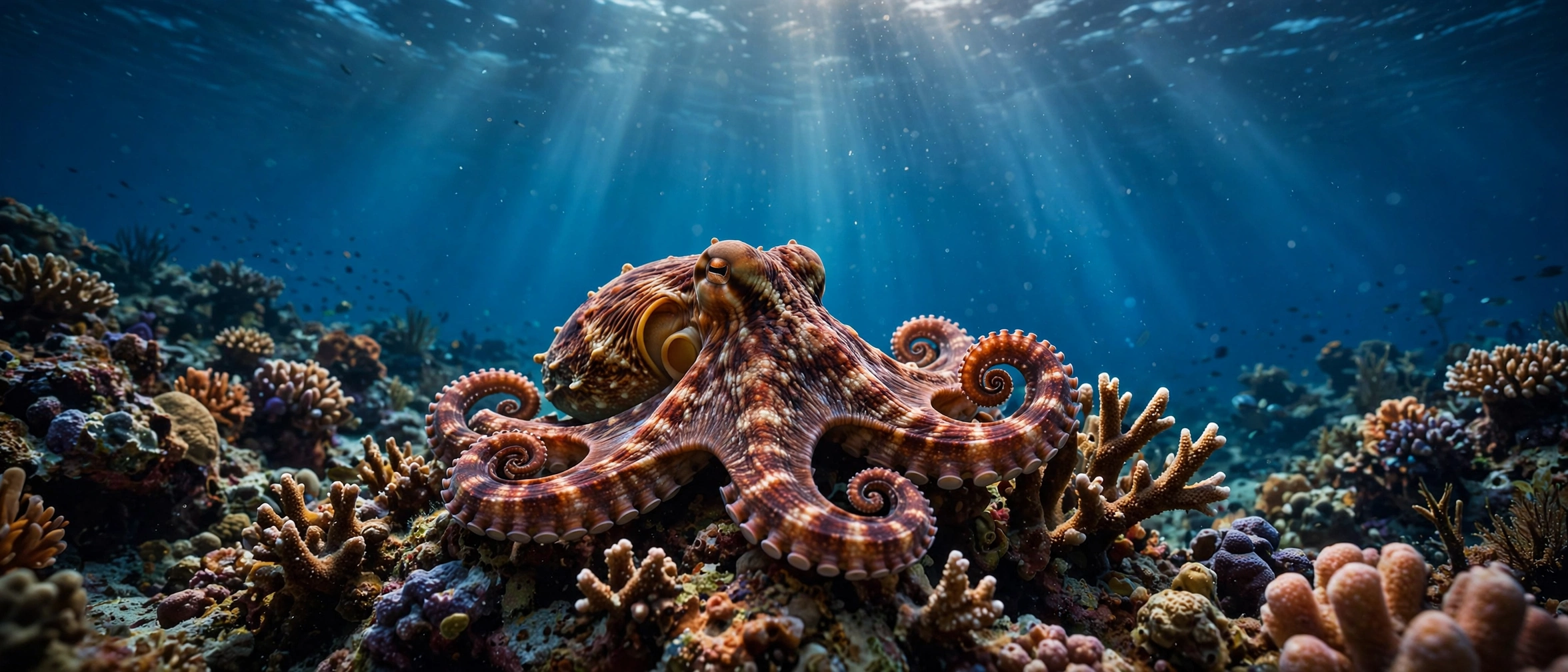
Of all the animals we meet on a reef, the octopus is the one we look for first. Not because it is the biggest or the brightest, but because it is the one most likely to be looking back. A turtle glides past. A ray passes underneath. An octopus stops, watches, and decides what to make of you. That two-way curiosity is what keeps us coming back to reefs, and it is why this page exists.
The animal we look for first
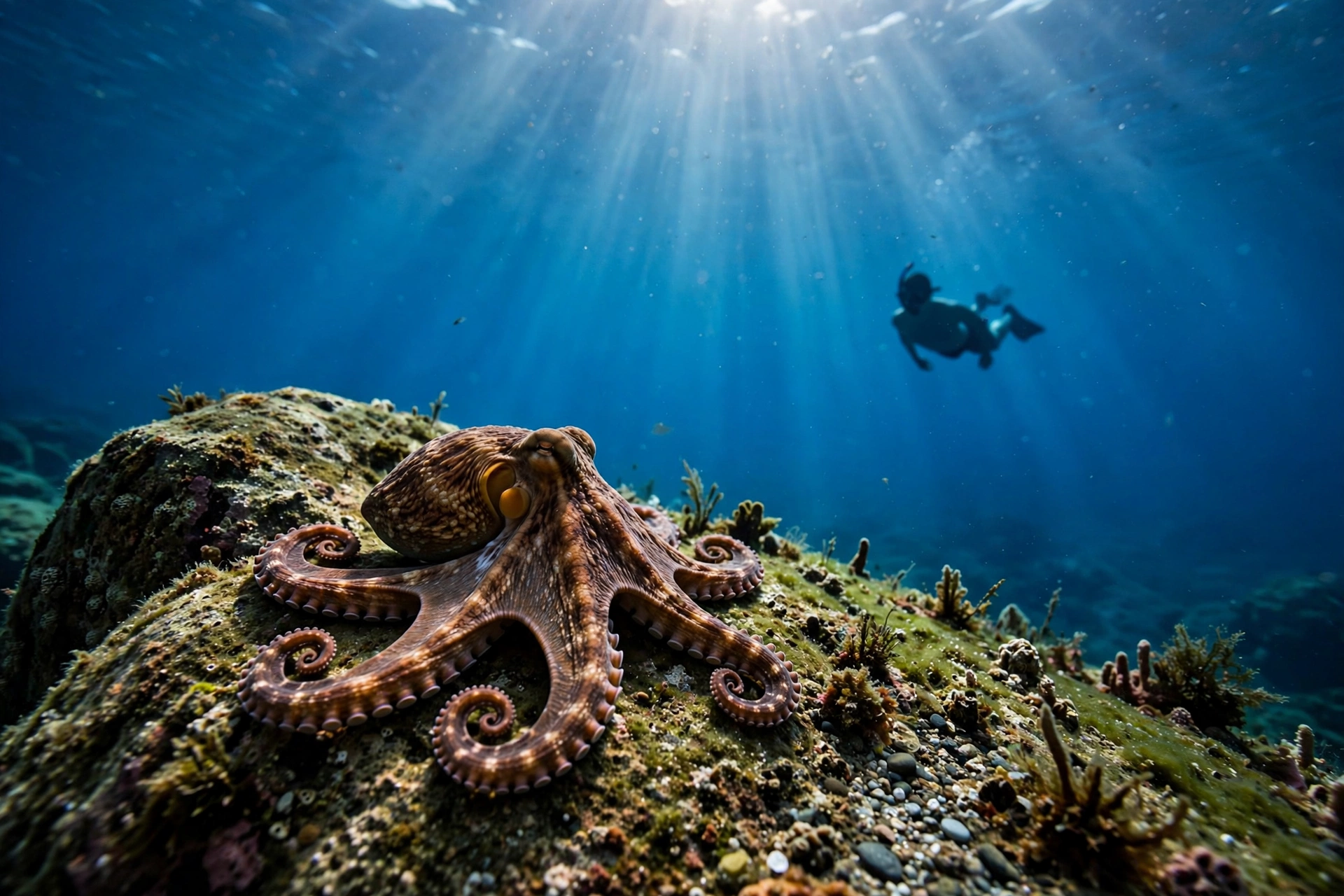
An octopus rarely announces itself. You find it the way you find anything shy and clever: by going slowly and looking for what does not quite fit. An eye in a hole in the coral. A patch of skin that shifts colour against the rock around it. An arm reaching out to taste the water, then pulling back.
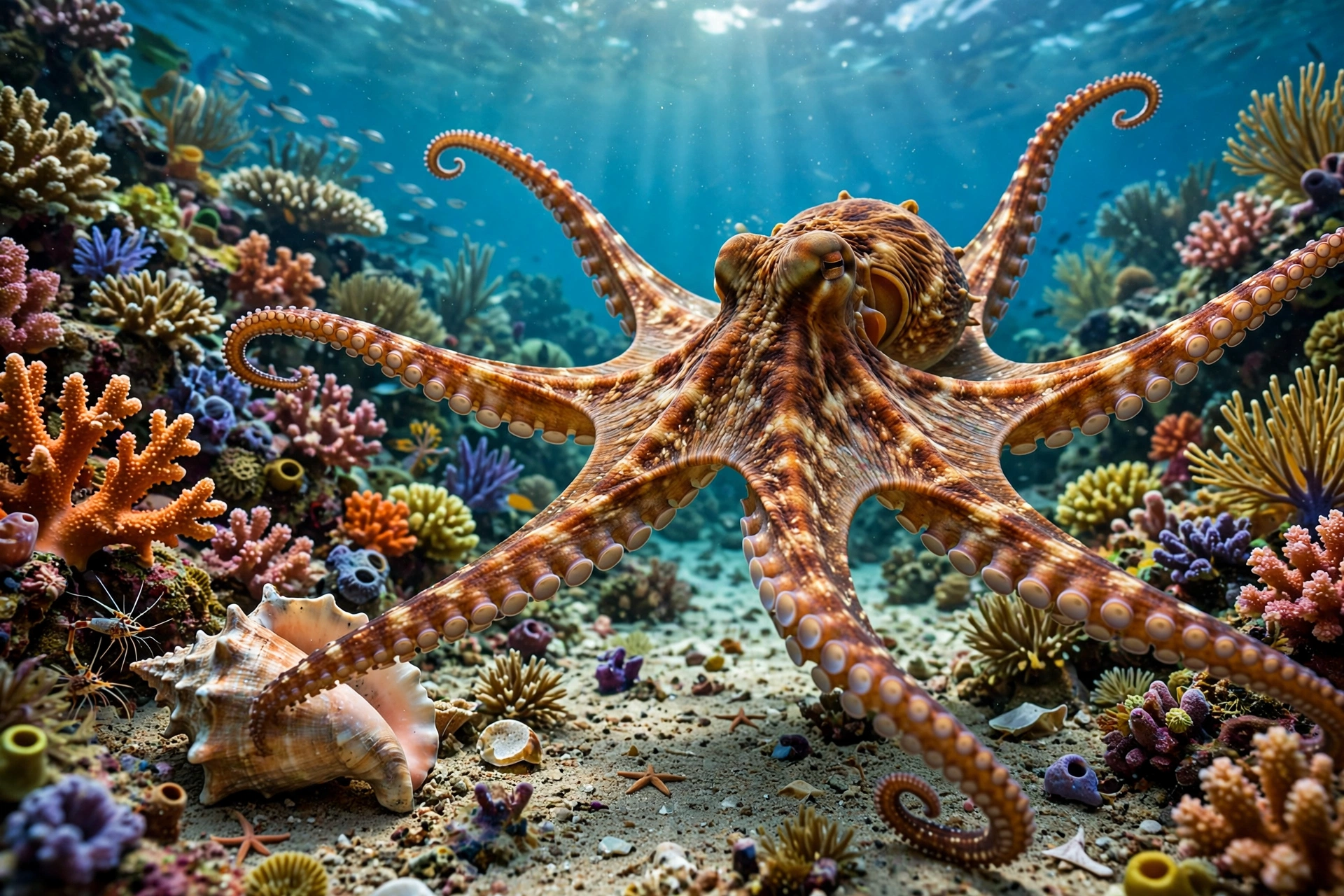
Meeting one feels different from meeting a fish. A fish carries on with its business. An octopus pauses. It studies you the way you study it, and for a few seconds the reef goes quiet around the two of you. That is the moment we plan our days around.
If you want that moment yourself, the method is simple: drift, don't chase. Move slowly, stay quiet, never touch, and never block the way out of its hole. Give it room and time, and often it will come out to look at you. A neat pile of empty shells near a hole is a good clue you have found a den; the animal itself may be watching you long before you spot it.
A brain folded into being
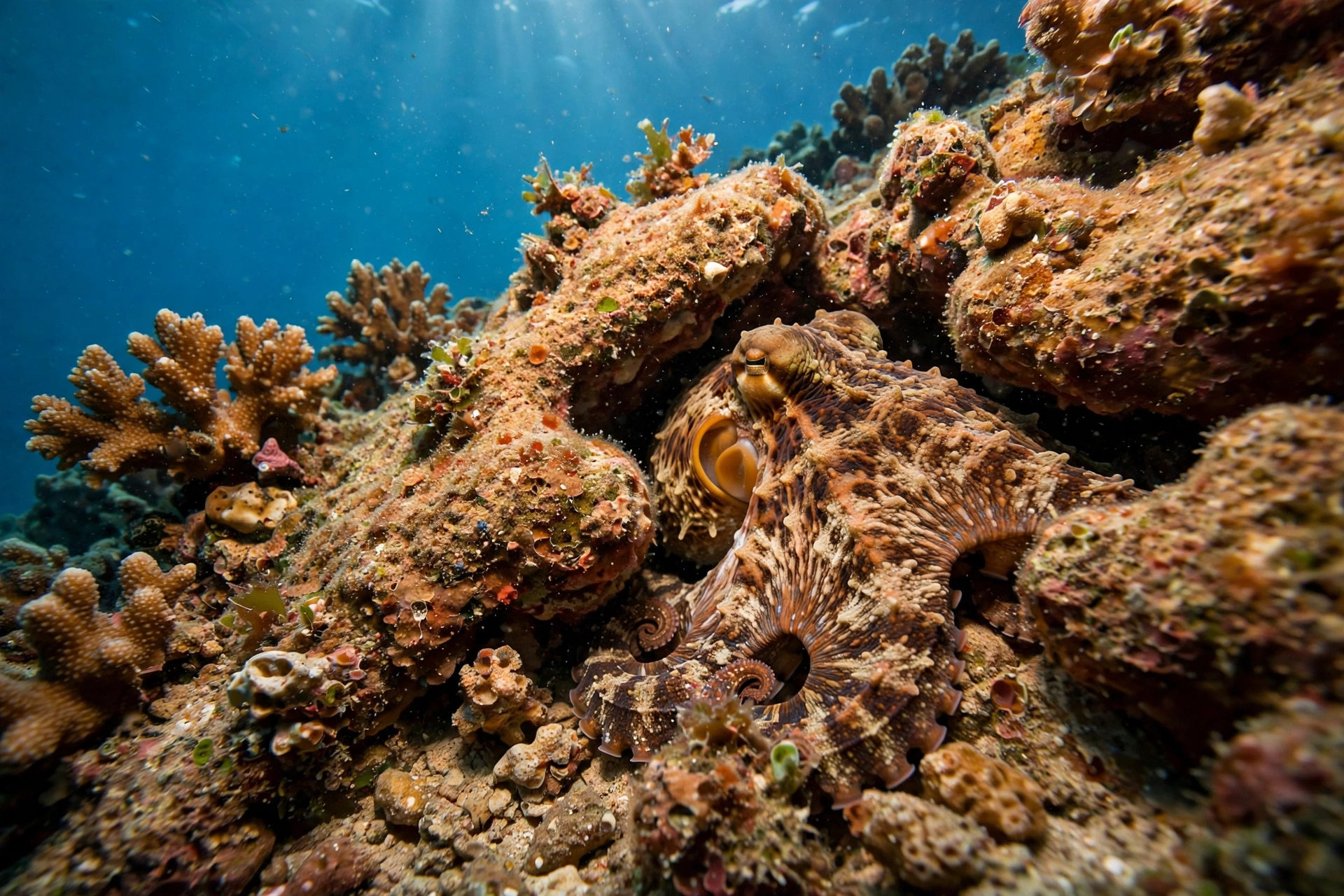
There is a reason an octopus can do what it does. Octopuses, squid and cuttlefish have exceptionally large and elaborately structured nervous systems for invertebrates, capable of problem-solving and camouflage so fast it looks like a trick. A study from the University of Vienna, published in Nature Communications in October 2026, suggests part of the answer lies not in the genes themselves, but in how the genome is folded.
DNA does not sit inside a cell as a neat, straight strand. It is folded into a tangled three-dimensional shape. Picture a long cord coiled in a drawer: two points far apart along the cord can end up lying side by side. When DNA folds that way, stretches that are far apart on the strand can touch, and start influencing how active each other's genes are.
Hundreds of millions of years ago, in the shared ancestor of octopuses, squid and cuttlefish, the genome was broken apart and stitched back together in a new order. That ancient reshuffle brought distant regions of DNA into contact, and over time those contacts wove into larger networks. The researchers call this regulatory entanglement: new patterns of gene activity could appear while the essential functions of the animal stayed stable.
The team mapped the folded DNA of a bobtail squid, a cuttlefish and a California two-spot octopus. The broad layout was largely the same across all three, but the finer connections differed between species, body tissues and stages of life, and many of them sat near genes tied to the nervous system. The octopus genome had rearranged the most, creating more new contacts between regions that once sat far apart.
On the reef, that science turns into something you can watch. When an octopus studies you from a crevice and ripples through colours and textures, you are seeing that brain at work in real time, a few feet away. The folding happened hundreds of millions of years ago. The result is looking back at you.
It can read a mirror
In June 2026, researchers at Dartmouth published a second piece of the puzzle in Current Biology. Three California two-spot octopuses learned to use a mirror to find food they could not see directly, the first time this has been shown in any invertebrate. Until now, the skill had only been documented in some vertebrates, including mammals and birds.
First the octopuses had to learn not to attack the reflection. A mirror image looks like another octopus, and their first instinct is to treat it as one. Through training with a crab they could only see in the mirror, they learned to treat the reflection as information instead, turning a corner to reach the real crab behind them.
Then came the test. Each octopus started in a box facing a mirror, while a projected crab image appeared behind it, visible only as a reflection. To find it, the animal had to leave the box, turn, and go to the correct side of the tank. They chose correctly about 73 percent of the time, and got faster with practice. Some even climbed the wall of the starting chamber, as if they were mapping what the mirror showed onto the shape of the tank.
One thing matters here, and it is worth saying plainly: this is not self-recognition. The octopuses did not recognise themselves in the mirror. They learned to use a reflection as a map of the world behind them, which is a different and, in its own way, more useful skill.
That is also why stillness works so well when you meet one in the wild. An octopus is mapping you, too. Sudden movement reads as a threat; a calm, slow snorkeler is something it can study. Stay still, give it time, and sometimes it will come out and study you back.
Meeting one on the reef
Look in crevices, under ledges and among coral rubble, and watch for a den: a hole with a tidy pile of empty shells outside it. Watch for an eye, for skin that changes colour or texture against the rock, for an arm reaching out to taste the water. Then be slow, be quiet, and be brief. If it pulls back into its hole, that is its answer, and you drift on.
That is why, on every reef we visit, the octopus is the animal we look for first. Not to catch a moment, but to share one, briefly, on its terms.
Where to swim with octopus — habitat-led destination picks →
Sources
- University of Vienna study on 3D genome organisation in cephalopods, published in Nature Communications, October 2026 (lead author Dr. Thea Rogers).
- Dartmouth study on mirror-guided navigation in Octopus bimaculoides, published in Current Biology, June 2026 (Kieseler et al.).