
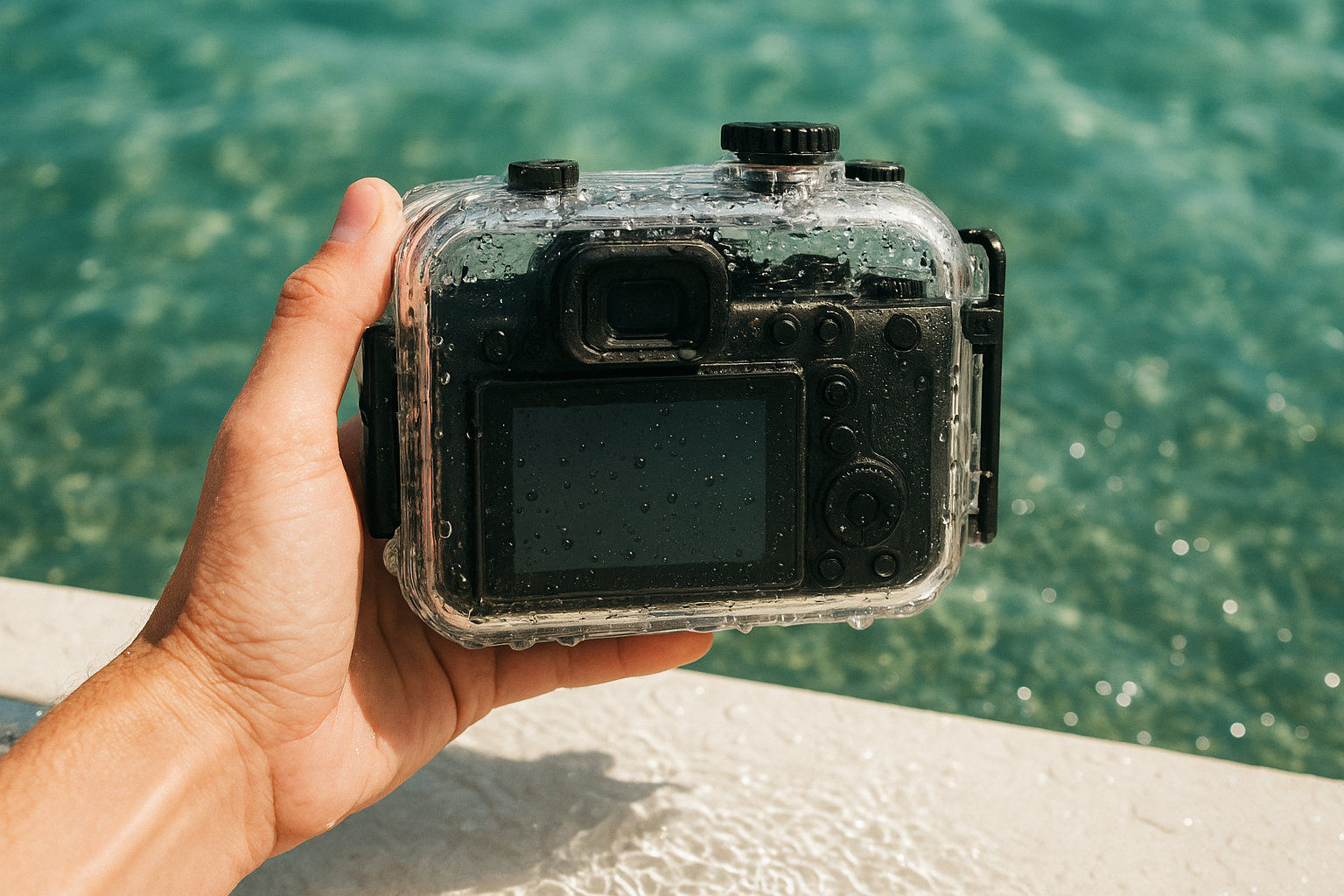
A compact underwater camera in its clear housing held above bright shallow water

The Best Underwater Camera for Snorkeling in 2026

A Double Fathom gear guide

Every snorkeler learns the same lesson on their first trip: the reef doesn’t wait for your camera to be ready. The turtle surfaces, the cuttlefish drifts past the coral, the school of jacks turns silver all at once — and whatever you’re holding, that’s the shot you get. Which is why we think about underwater cameras for snorkeling as one question: what can you hold at arm’s length, while swimming slowly, that won’t mind the water?

Our answer, on this page and on the gear hub, is the GoPro MISSION 1 — GoPro’s new flagship, with the biggest sensor they’ve ever put in a camera this size, 8K video, and waterproofing to 66 feet with no housing at all. Alongside it, the Earth Pak Waterproof Dry Bag (10L) as the companion accessory pick: it doesn’t swim with you, but it keeps the phone, wallet, and towel you left on the boat dry all day — and a dry phone at the end of a trip is worth more than most travelers expect.

We keep this guide honest the same way we keep the gear hub honest: every product here already ships on our gear hub, every affiliate link is the exact link from that page, and every pro and con below matches what we already say about each product. No invented tests, no borrowed opinions, and no prices in the copy — prices change, and a guide that quotes them goes stale the day it’s written.

Heads up: some links on this page may earn us a commission at no extra cost to you. It keeps our reef guides free.

Our 2026 picks at a glance

PickTypeBest forStandout
GoPro MISSION 1Flagship action camera (underwater pick)Capturing the reef in flagship quality50MP 1-inch sensor, 8K video, waterproof to 66 feet with no housing
Earth Pak Waterproof Dry Bag (10L)Companion accessory — dry bagKeeping valuables dry on the boatRoll-top with welded seams — waterproof phone case included

The picks, in detail

GoPro MISSION 1

Flagship action camera — the camera we swim with at Double Fathom

The MISSION 1 is GoPro’s new flagship, and the specs that matter to a snorkeler are the ones our gear hub leads with: a 50MP 1-inch sensor — their biggest ever in a camera this size — 8K video, and waterproofing to 66 feet with no housing, far beyond snorkel depth. What that means in practice is simple: the camera goes wherever you swim, with nothing screwed onto it, nothing to flood, and nothing between you and the reef but water.

The underwater payoff is image quality. A 1-inch sensor gathers more light than the small sensors in most action cameras, and light is what a reef is made of — dappled, shifting, and always a little dimmer than it looks to your eye. Pair that with HyperSmooth stabilization, which keeps handheld clips smooth even while you’re finning, and the difference shows up at home: steady, sharp clips of exactly what you saw, instead of shaky blur you’ll never watch twice.

The technique we teach is the one on the gear hub: hold it at arm’s length, swim slowly, and let the reef fill the frame. A slow approach is also how you see more — fish react to thrashing swimmers and ignore calm ones. The footage is the souvenir you actually keep, and this is the camera we hand to travelers who want the reef on film the way it looked in their mask.

Pros

  • 50MP 1-inch sensor — their biggest ever in a camera this size
  • 8K video
  • Waterproof to 66 feet with no housing, far beyond snorkel depth
  • HyperSmooth stabilization keeps handheld clips smooth
  • The camera we swim with at Double Fathom

Cons

  • A flagship camera — a bigger investment than a basic underwater point-and-shoot
  • 8K clips are large files you’ll want to offload between dive days

Best forCapturing the reef in flagship quality.

Earth Pak Waterproof Dry Bag (10L)

Companion accessory — keeps the rest of your kit dry

A camera guide that ignores the boat is half a guide. Your MISSION 1 can swim with you, but the spare battery, the towel, the car keys, and the phone you leave behind all live in the one place every snorkel boat has: a pile of bags at the stern, one splash away from wet. The Earth Pak dry bag is the /gear pick for exactly that problem.

The design is the classic one done right: a roll-top closure you fold down three or four times and clip, over welded seams that keep water out. Ten liters is the right size for a day’s essentials — phone, wallet, towel, and a dry shirt — without becoming the bag that swallows the whole deck. Our gear hub notes that a waterproof phone case is included, which covers the device most people are most nervous about leaving unattended.

The habit we teach on every trip: one bag per person or per couple, everything valuable in it, rolled and clipped before the boat leaves the dock. It costs you a minute in the morning and buys you a dry phone at the end of the day — and it pairs with the MISSION 1 the way a mask pairs with a snorkel. One is the pick you swim with; this is the one that keeps everything else waiting safely for you.

Pros

  • Roll-top dry bag with welded seams
  • Keeps your phone, wallet, and towel dry on the boat
  • Waterproof phone case included
  • 10L — sized for a day’s essentials

Cons

  • It protects what’s on the boat, not the gear you swim with
  • Roll-top needs a few folds to seal — rushed closing loses the seal

Best forKeeping valuables dry on the boat.

How to choose an underwater camera for snorkeling

Decide what you’re actually shooting

Be honest about the goal first, because it changes everything else. If you want clips of turtles and reef scenes to actually watch again at home, an action camera with stabilization — like the MISSION 1 — is the tool. If you mostly want a few stills and the convenience of a device you already carry, a ruggedized phone case can be enough, and the dry bag’s included waterproof phone case covers the phone-first traveler. Cameras you don’t take out of the drawer don’t take pictures; pick the one whose habit you’ll actually keep.

Waterproofing without a housing

A housing is the traditional answer to water, and it’s a good one — until it isn’t. Every housing is an extra seal to maintain, an extra thing to fog, and an extra layer between you and the settings. A camera that is waterproof on its own removes that whole failure mode. The MISSION 1’s rating — 66 feet with no housing — matters to a snorkeler less for the depth than for the margin: the top few meters where snorkeling happens aren’t even close to the limit.

Stability matters more underwater than on land

On land, a shaky clip is a minor annoyance. Underwater, with no horizon and everything moving, a shaky clip is unusable — and swimming makes every handheld shot shake. HyperSmooth-style stabilization is the feature that separates footage you’ll share from footage you’ll delete, and it’s why we weight it as heavily as sensor size in this guide. The other half is technique: hold the camera at arm’s length, swim slowly, and let the reef fill the frame.

Plan for light, not for megapixels

Water eats light fast — color first, then brightness — and no spec sheet changes that. The two habits that work: shoot in the best light of the day (late morning through mid-afternoon, when the sun is high), and get close. A meter of water between you and the subject costs you more color than any camera setting will give back. A bigger sensor like the MISSION 1’s 1-inch chip helps at the edges of the light, but closeness and timing help every camera.

Protect the camera that protects the memories

Between swims, the camera lives on the boat — which is where the dry bag earns its keep. Roll the top, clip it, and the splash risk that ends electronic gear stays out. Rinse the camera in fresh water after each swim day (salt is hard on buttons and lens seals), dry it in the shade, and charge it overnight so the next day starts full. The footage is the souvenir you actually keep; treat it like it.

Underwater cameras — questions

Is the GoPro MISSION 1 waterproof enough for snorkeling?

Yes — comfortably. It is waterproof to 66 feet with no housing, far beyond snorkel depth. Snorkeling happens in the top few meters of the water, so the camera can go with you everywhere you swim without any extra case to leak or fog.

Do I need a separate housing for the GoPro MISSION 1?

No. The MISSION 1 is waterproof to 66 feet with no housing — that is one of the main reasons we recommend it for snorkelers. A housing adds bulk and an extra seal to maintain; here there isn’t one, so there’s nothing extra to fail.

How do I keep my other gear dry on the boat?

That is the Earth Pak dry bag’s job. Roll the top, clip it closed, and your phone, wallet, and towel stay dry and sand-free on the boat — the welded seams keep water out, and a waterproof phone case is included in the bag.

Why does Double Fathom recommend an action camera instead of a regular camera?

Because of where we swim. Snorkeling is wet, sandy, and hands-busy — you want something you can hold at arm’s length while swimming slowly, that survives spray and sand without a housing, and that stabilizes handheld clips. The MISSION 1 does all of that, and the footage is the souvenir you actually keep.

The full gear hub

A camera fills the memory; the rest of the kit fills the trip. The full gear hub covers everything we recommend for the water — masks, snorkels, fins, wetsuits, rash guards, and reef-safe sunscreen — each with the same honest why-we-pick-it note.

Open the full gear hub