
Best Snorkeling in Zanzibar
6 min read · Field guide
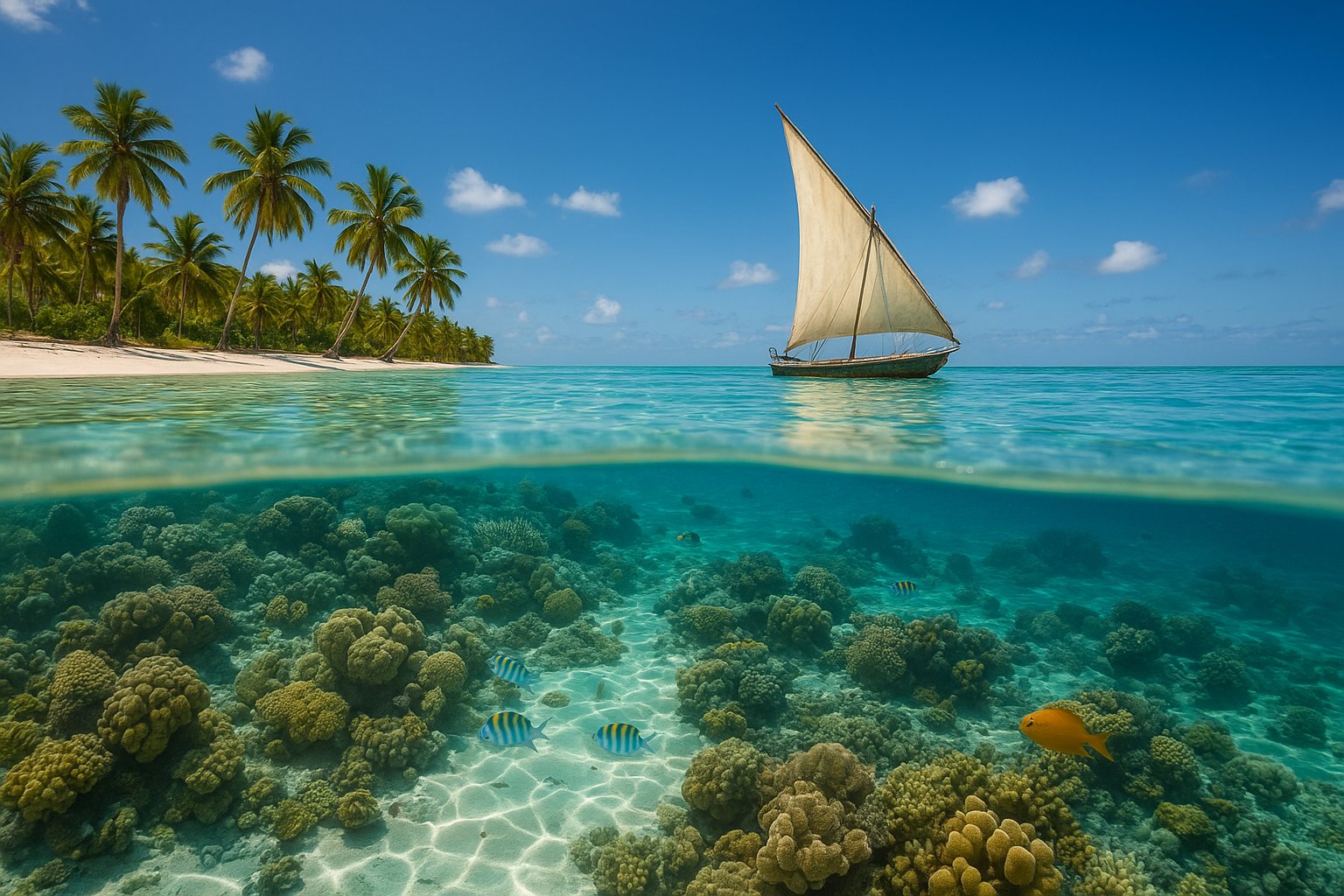
Zanzibar pairs some of the Indian Ocean's finest snorkeling with one of its easiest trips. Mnemba Atoll's protected coral gardens hold 300-plus fish species, turtles and resident bottlenose dolphins in bath-warm water, reached by a short boat ride from the beach — no liveaboard required. Add Stone Town's spice-island culture and direct flights from Europe and the Gulf, and it is the rare world-class reef you can do in a long weekend.
Seasonal guidance, not a forecast — no live tide tables, weather or marine advisories here; check local conditions before you go.
Why Zanzibar is great for snorkeling
Zanzibar's reefs sit unusually close to a very easy trip. Mnemba Atoll's protected coral gardens hold 300-plus fish species, green turtles, rays and resident bottlenose dolphins in bath-warm water, reached by a short boat ride from the beach — no liveaboard required, which is rare for reef quality this good. The atoll is a genuine marine conservation area rather than an unprotected reef with a dive shop on it.
The rest of the trip delivers too: Stone Town's spice-island culture, direct flights from Europe and the Gulf, and beach bases from Nungwi to Matemwe. The planning factor is the monsoon rather than temperature, because the water stays warm all year.
- Mnemba Atoll's protected coral gardens, 300-plus fish species
- Green turtles and resident bottlenose dolphins
- Bath-warm water year-round — a rash guard, not a wetsuit
- Beach-side reef at Nungwi and Kendwa for an easy second day
Best sites to prioritize
Mnemba Atoll is the flagship: a private island ringed by the Mnemba Island Marine Conservation Area (MIMCA), with shallow coral gardens, green turtles, rays and bottlenose dolphins that operators meet almost daily. Two access facts matter. Landing on the island itself is for resort guests only, and the surrounding atoll is open to the public only via organised boat tours — there is no independent access. A MIMCA conservation fee applies, which operators quote at roughly $10–25 per person (observed at $10, $15 and $25 across three operators) and usually bundle into the tour price. Half-day group tours run roughly $50–150+ per person depending on inclusions; re-verify both figures at booking.
Chumbe Island Marine Park, a small protected island off Stone Town, holds some of the healthiest and most pristine coral in the region thanks to strict conservation — it feels untouched, and day trips run from Stone Town.
Nungwi and Kendwa reefs on the north coast are the easy option: clear water and lively reefs you can snorkel straight from the beach, with nearby Tumbatu Island on boat days. They make a good second-day filler around the Mnemba trip.
When to go & conditions
Zanzibar's planning factor is the monsoon winds, not temperature — the water is warm all year. The Kaskazi, the northeast monsoon from roughly December to March, brings lighter winds (about 20–27 km/h), calmer seas and warm, humid air: the easiest snorkeling conditions of the year, and the short dry season, so visibility is at its best. The Kusi, the southeast monsoon from roughly June to September, brings stronger breezes (about 27–29 km/h in July), cooler nights and choppier offshore water — the Mnemba crossing can be rough — but it is squarely in the dry season, so visibility stays good and it is peak season overall.
The long rains, roughly March to May, bring heavy showers, rougher seas and reduced visibility; it is the one window to avoid, and some lodges and operators pause. The short rains in November are lighter, often just a few hours a day, and make a decent value window with fewer crowds. The sweet spots for snorkeling are June to October and December to February, when visibility commonly runs 15–30 m.
Water temperature is bath-warm year-round, roughly 25–29°C, so a rash guard is about sun protection rather than warmth — the Kusi months can feel a touch cooler at the surface, but nobody needs neoprene. The atoll's snorkel zones sit in sheltered shallows with generally mild currents, but Zanzibar's big tidal range matters: several operators time departures around the incoming tide, when clear ocean water floods in and visibility peaks. In Kusi season the southeast wind can make the Mnemba crossing choppy, so go with the operator's call on the day and keep a flex day in the plan.
Practical tips
Fly into Abeid Amani Karume International Airport (ZNZ). There are direct international flights from Europe and the Middle East; otherwise you hop from Dar es Salaam (about a 20-minute flight) or take the ferry from Dar (about two hours). The Mnemba day trips depart from the northeast coast — Nungwi, Muyuni or Matemwe beaches — with most operators offering hotel pickup. The boat ride to the atoll runs roughly 20–40 minutes depending on departure point and sea state, and morning departures around 8:00–8:30 are standard, timed for calmer seas.
On entry, most visitors — including US, UK, EU, Canadian and Australian passport holders — need a Tanzania visa, and one visa covers Zanzibar and the mainland. Apply for the e-visa through the official portal at visa.immigration.go.tz: about $50 for a single entry, but US citizens must take the $100 multiple-entry visa, and you should allow up to about ten days for processing. Visa on arrival at ZNZ is also available at about the same cost. Passports need 6+ months validity with blank pages, plus proof of onward travel and accommodation. Beware lookalike agency sites and use the .go.tz domain. Since October 2024 every foreign visitor must also buy Zanzibar's own government travel insurance, about $44 per adult for up to 92 days, in advance at visitzanzibar.go.tz — your own policy does not replace it and you can be denied entry without it. A yellow fever certificate is required if you transit more than 12 hours through an endemic country, and it is worth talking to a travel clinic about hepatitis A, typhoid and malaria prophylaxis before flying.
The currency is the Tanzanian shilling (TZS). USD is widely accepted in tourist areas and for visas and tips, cards work at larger hotels, and there are ATMs in Stone Town and Nungwi, with mobile money (M-Pesa) everywhere locally. Zanzibar is predominantly Muslim with a rich Swahili culture, so dress modestly away from the beach — shoulders covered, knees below the knee — ask before photographing people, and keep alcohol to hotels, bars and restaurants. On health, Mnazi Mmoja Hospital on Kaunda Road in Stone Town is the island's main government referral hospital, with around 400 beds and a 24/7 emergency department; older reporting flags no island-wide ambulance service, so arrange transport in an emergency and carry dive and medevac travel insurance. No decompression chamber on Zanzibar could be confirmed — ask operators directly about emergency oxygen and evacuation plans. Travel-admin facts for this destination are in the Concierge panel on the destination page.
Book your Zanzibar, Tanzania snorkeling
Every button opens one of our booking partners live — tours on Viator, flights on Aviasales, hotels on Booking.com — where you set your own dates and see current prices and availability.
Affiliate links — we may earn a commission at no extra cost to you. No prices are shown here: each partner's live site shows prices and availability for your dates.
Planning this trip?
Get the whole journey built end-to-end — flights, stays, boat days, gear and day-by-day timing notes — by the Double Fathom Concierge for a one-time $29. Re-plan any time, chat support through the trip, a destination-specific packing list, curated off-menu operators, and a printable offline PDF itinerary.
Secure checkout by Stripe — pay by card, receipt by email. A one-time, per-trip purchase — nothing recurring, and no rush either way.
Get the occasional best-reef dispatch
Trip-planning tips, seasonal reef picks and new-destination notes. No spam, unsubscribe anytime.
Explore the destination
Zanzibar pairs some of the Indian Ocean’s finest snorkeling with one of its easiest trips: Mnemba Atoll’s protected coral gardens hold 300+ fish species, turtles and resident bottlenose dolphins in bath-warm water, reached by a short boat ride from the beach rather than a liveaboard. Add Stone Town’s spice-island culture and direct flights from Europe and the Gulf, and it is the rare world-class reef you can do in a long weekend. The planning factor is the monsoon winds, not the temperature: the long rains (roughly March–May) bring heavy showers and reduced visibility, while the Kusi (roughly June–September) can make the Mnemba crossing choppy.
Zanzibar, Tanzania destination guide →