Best Snorkeling in Guadeloupe
6 min read · Field guide
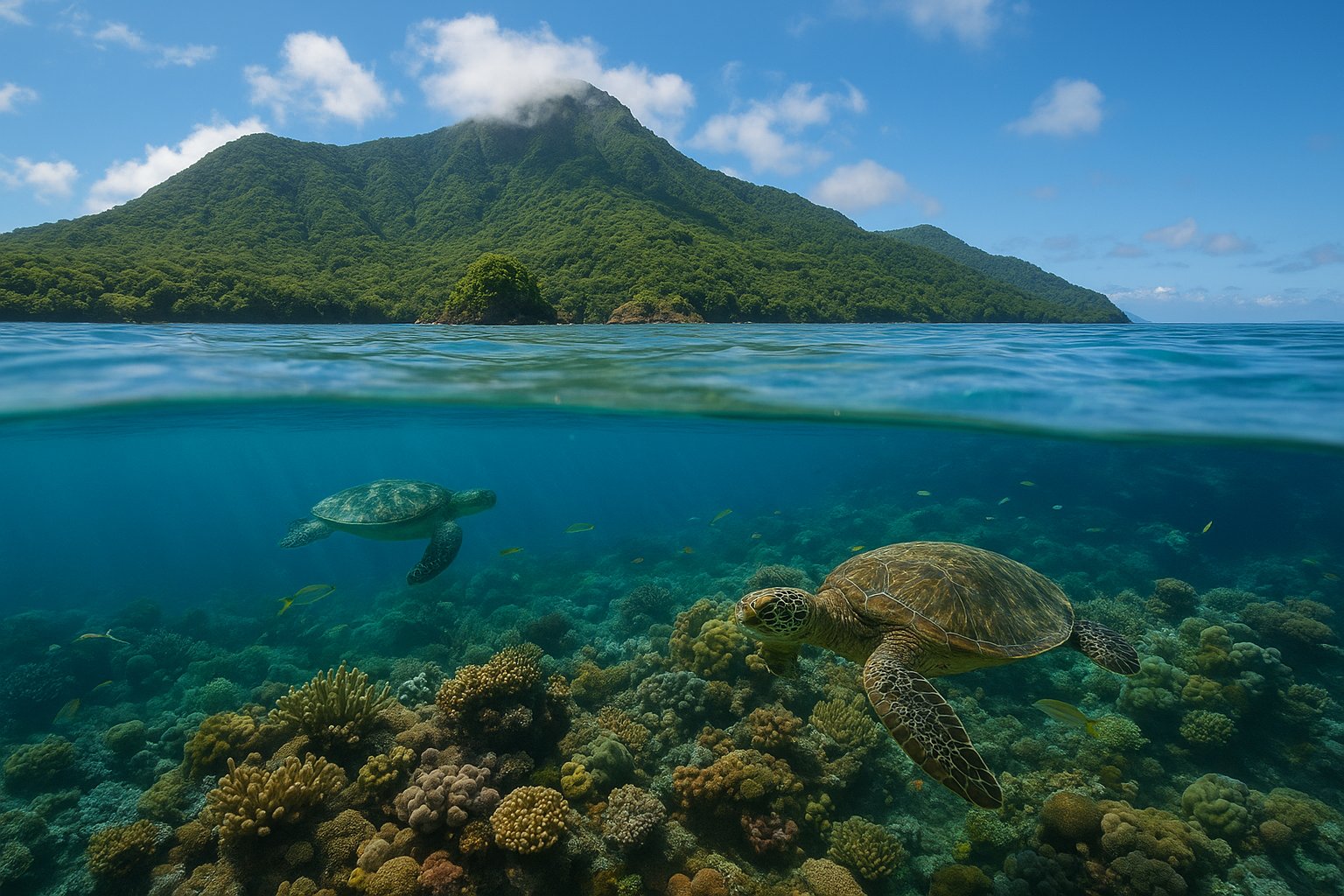
Guadeloupe is the French Caribbean's snorkeling crown jewel. The Réserve Cousteau — the marine reserve Jacques Cousteau himself championed and filmed in — sits in gin-clear water off Basse-Terre's volcanic west coast, with green turtles grazing the shallows, tarpon patrolling the drop-offs and Cousteau's own statue resting on the seabed. It is Europe in the tropics, wrapped around genuinely world-class Caribbean reefs, plus satellite islands most visitors never reach.
Seasonal guidance, not a forecast — no live tide tables, weather or marine advisories here; check local conditions before you go.
Why Guadeloupe is great for snorkeling
Guadeloupe's headline site is a marine reserve that Jacques Cousteau himself championed and filmed in. The Réserve Cousteau sits in gin-clear water off Basse-Terre's volcanic west coast, part of the Guadeloupe National Park's protected marine area, with green turtles grazing the shallows, tarpon patrolling the drop-offs and Cousteau's own statue resting on the seabed.
What makes the island unusual for the Caribbean is the combination: a French overseas department, so euros, French hospitals and EU standards, wrapped around genuinely world-class reefs and a set of satellite islands — Petite-Terre and Les Saintes — that most visitors never reach. The good snorkeling is concentrated on the sheltered west coast, which keeps the days easy once you are based on the right side of the island.
- The Réserve Cousteau — a national-park marine area, named for Captain Cousteau
- Green turtles, tarpon, barracuda and parrotfish on one reef system
- Day-trip islands: Petite-Terre and Les Saintes
- French infrastructure — euros, cards, French-standard hospitals
Best sites to prioritize
The Réserve Cousteau, at the Pigeon Islands (Îlets Pigeon) off Malendure in Bouillante, is the headline. It is part of the Guadeloupe National Park's protected marine area, named for Captain Cousteau, who pushed for its protection and filmed here. The snorkel zones include the Coral Garden, the Japanese Garden and the Turtle Garden, with tarpon, barracuda, parrotfish and yellowtail snapper as regulars. It draws around 50,000 visitors a year, and you have to get roughly 1 km offshore to the islets — the beach shallows hold little.
Petite-Terre is a day-trip-only island reserve off Saint-François on Grande-Terre, famous for its iguanas, with pristine and crowd-free snorkeling on the lagoon side. It is reached by day-boat excursion — verify day-trip operators at booking.
Les Saintes, and Terre-de-Haut in particular around Pain de Sucre, is the prettiest bay in the archipelago, with clear-water snorkeling off volcanic headlands and an easy ferry from Trois-Rivières — verify specific snorkel beaches at booking.
When to go & conditions
January to April, the carême or dry season, is the sweet spot: sun, short-lived showers, the year's most comfortable air — and, crucially, the cleanest water. Basse-Terre's west-coast visibility depends on what washes off the rainforest volcano, and the dry months run clear. Water sits around 27–28°C, so a rash guard is plenty. December and early January give dry-season conditions with holiday-season crowds and prices, the compromise if you cannot do late winter. May to June is shoulder season: warmer, quieter, with occasional showers, but still good snorkeling before the rains settle in.
June to November is the wet and hurricane season, and it is worth avoiding for a snorkel-first trip. Atlantic hurricane season peaks around 10 September, and even non-hurricane systems can kill a week — Tropical Storm Fiona in September 2022 dropped 534 mm of rain on Basse-Terre and cut roads. Peak coral heat stress and the murkiest water land roughly late October to mid-November. If you must go then, buy flexible everything and watch marine forecasts.
Water is warm all year, roughly 27–30°C, coolest around February–March and warmest in September–October. Visibility is best in the dry season, roughly January to April, commonly 15–25 m on good days, while the wet season brings runoff, plankton blooms and sargassum that can cloud things fast — September to November is the murkiest window. The Caribbean, or leeward west side, is generally calm and sheltered, with the snorkel zones close to shore in easy water; the Atlantic east side runs rougher with real surf and rip currents, so stick to the west unless you are with a local operator. Hurricane season is the planning factor: a single system can cancel boat days for a week, so build flex days into any summer or fall trip.
Practical tips
Fly into Pointe-à-Pitre International Airport (PTP) — officially renamed Guadeloupe International Maryse Condé Airport in January 2025. US service includes American Airlines from Miami and JetBlue from New York JFK, and the schedules are seasonal, so verify current timetables when booking. To reach the Réserve Cousteau, it is about 45–60 minutes by road from PTP to Malendure beach in Bouillante, on Basse-Terre's Caribbean west coast, and a rental car is effectively essential because the island is car-dependent and the good snorkel launches are scattered. Operators cluster at Malendure: a glass-bottom boat at about €21 for 75–80 minutes including roughly 30 minutes of snorkeling with gear provided, kayak rental with about a 30-minute paddle to the islets, and guided two-hour snorkel excursions to the Japanese Garden, Coral Garden and Turtle Garden. Re-verify those prices at booking.
Guadeloupe is a French overseas department, so French immigration rules apply: US passport holders are visa-free for up to 90 days, the same regime as mainland France, but re-check the current country list with French consular sources before booking. The currency is the euro, cards are widely accepted and there are ATMs island-wide. French and Guadeloupean Creole are spoken, and English thins out fast outside the main tourist zones, though several Malendure operators have English-speaking staff — ask when booking. An offline French pack and a few greetings genuinely go a long way.
On health, the Centre Hospitalier Universitaire de Pointe-à-Pitre/Abymes is the main teaching hospital with French and EU standards, and a secondary source reports a hyperbaric chamber for diving incidents — verify chamber status if you are relying on it. Emergency numbers are 15 for SAMU medical, 17 for police, 18 for fire and 112 as the EU standard. Tap water is safe in developed zones and pharmacies are everywhere for minor issues. Travel-admin facts for this destination are in the Concierge panel on the destination page.
Book your Guadeloupe snorkeling
Every button opens one of our booking partners live — tours on Viator, flights on Aviasales, hotels on Booking.com — where you set your own dates and see current prices and availability.
Affiliate links — we may earn a commission at no extra cost to you. No prices are shown here: each partner's live site shows prices and availability for your dates.
Planning this trip?
Get the whole journey built end-to-end — flights, stays, boat days, gear and day-by-day timing notes — by the Double Fathom Concierge for a one-time $29. Re-plan any time, chat support through the trip, a destination-specific packing list, curated off-menu operators, and a printable offline PDF itinerary.
Secure checkout by Stripe — pay by card, receipt by email. A one-time, per-trip purchase — nothing recurring, and no rush either way.
Get the occasional best-reef dispatch
Trip-planning tips, seasonal reef picks and new-destination notes. No spam, unsubscribe anytime.
Explore the destination
Guadeloupe is the French Caribbean’s snorkeling crown jewel: the Réserve Cousteau, the marine reserve Jacques Cousteau himself championed and filmed in, sits in gin-clear water off Basse-Terre’s volcanic west coast — green turtles grazing the shallows, tarpon patrolling the drop-offs, and Cousteau’s own statue resting on the seabed. It is Europe in the tropics (euros, French hospitals, EU standards) wrapped around genuinely world-class Caribbean reefs, plus the satellite islands — Petite-Terre and Les Saintes — that most visitors never reach. Go in the dry season: the cleanest west-coast water runs roughly January to April, and June to November is hurricane season.
Guadeloupe destination guide →